
Call 1930 to report crypto fraud in India. The first two hours after a scam are your “Golden Hour,” the only time period to freeze funds, file a complaint, and protect your identity before the money disappears.
In 2026, fraudsters operate through AI voice calls, Telegram task-earning traps, and fake crypto investment apps.
This article gives you the exact steps to report the fraud, collect evidence, work with the right authorities, and avoid the recovery scams that follow.
What To Do Immediately After Crypto Fraud in India (First 2 Hours)
Call 1930 and contact your exchange within the same hour. These two actions give authorities the best chance to freeze funds before they become untraceable.
1. Call 1930: National Cyber Crime Helpline for Crypto Fraud
Keep your UTR number or TxID ready before you dial. Request an emergency fund freeze directly. This helpline connects to partner banks and select Indian exchanges, but works best within the first two hours.
2. Contact Your Crypto Exchange to Freeze Funds
Raise a support ticket immediately after calling 1930. Send your transaction hash (TxID), acknowledgment number, and a written freeze request together. Attaching the complaint number flags your case as an active legal matter and prioritises it.
How To Report Crypto Fraud Online in India (Step-by-Step Process)
The 1930 call buys you time. The official complaint creates the legal record that gives police, courts, and exchanges the authority to act. Filing correctly and completely from the start prevents delays that cost victims their cases.
1. File a Complaint on the National Cyber Crime Reporting Portal
Go to cybercrime.gov.in to officially open your case. This filing is mandatory before you can register an FIR or request any formal cooperation from an exchange.
Step 1: Click “Report Other Cyber Crime” on the homepage.
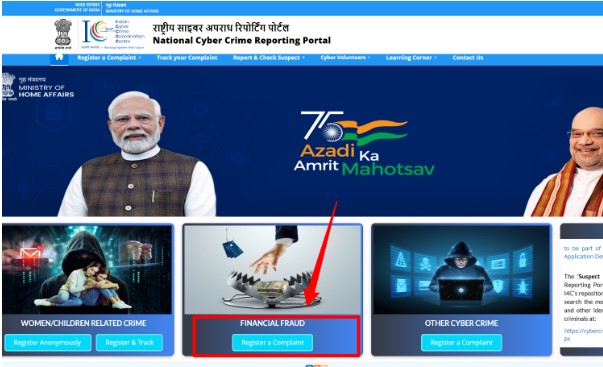
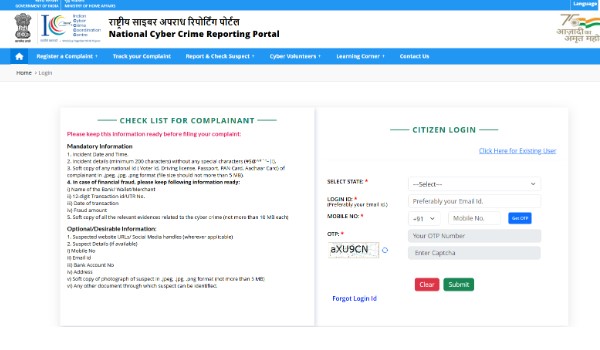
Step 2: Complete the Citizen Login with your mobile number and OTP.
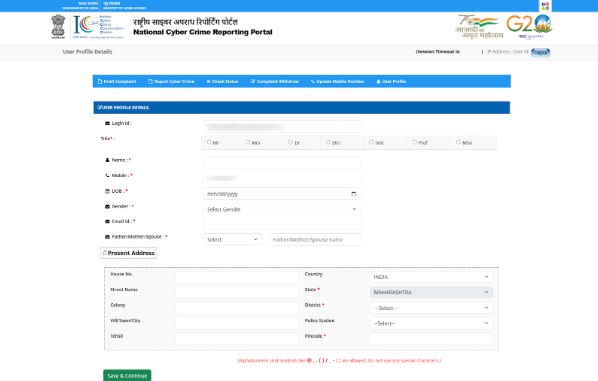
Step 3: Fill in your Profile Details, name, ID proof, and contact information.
Step 4: Select “Financial Fraud” and enter your Incident Details: date, amount, TxID, and how the fraud happened.
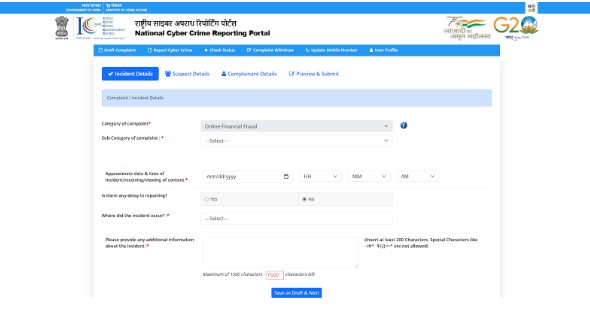
Step 5: Enter Suspect Details: wallet address, phone number, and any scammer contact information you have.
Step 6: Fill in your Complainant Details and review everything on the Preview page.
Step 7: Submit and save your acknowledgment number immediately.
Pro Tip: The portal slows down after 10 PM due to high traffic volume. File before 9 AM for fewer timeout errors and a faster submission.
That acknowledgment number is your case reference across every step that follows. Save it in at least two places before you close the browser.
2. Report the Scam Contact on Sanchar Saathi (Chakshu Portal)
The scammer reached you through a specific channel: a WhatsApp message, a Telegram link, or a phone call. That first contact point is reportable, and filing it on Sanchar Saathi triggers a nationwide block on the scammer’s number.
Visit sancharsaathi.gov.in/sfc and complete the following:
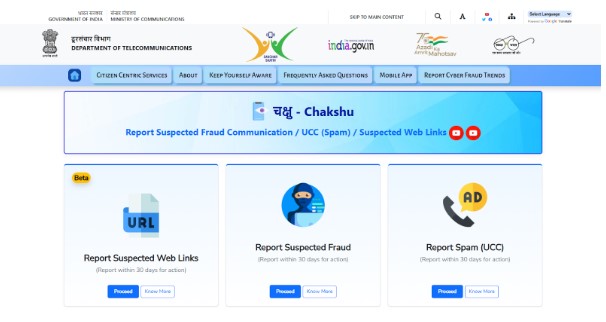
Step 1: Submit the phone number the scammer used to contact you.
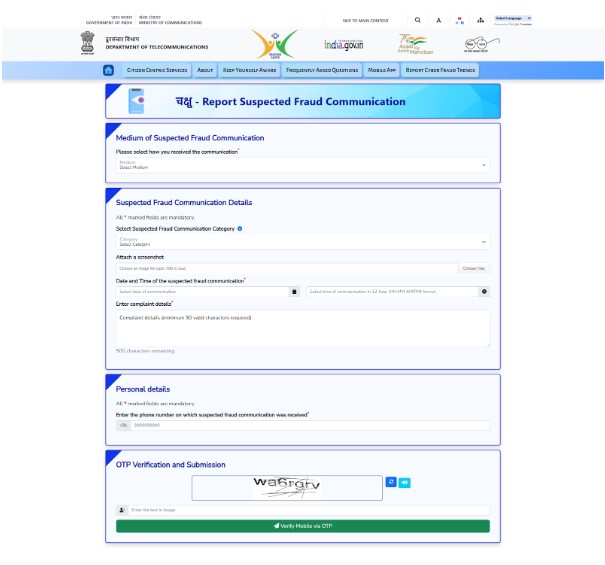
Step 2: Report the Telegram handle or WhatsApp link tied to the scam.
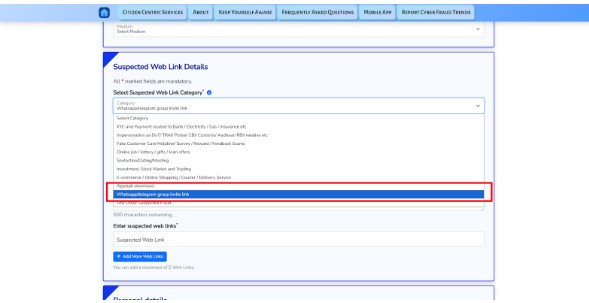
Step 3: The system flags the number for the SIM and IMEI block across all Indian telecom networks.
This report protects other potential victims and strengthens your own complaint record with a second government filing.
3. Share Your Complaint Number With the Crypto Exchange
Your cybercrime.gov.in acknowledgment number carries legal weight. Send it directly to the exchange’s legal team to formally activate their obligation to cooperate.
- Step 1: Email the exchange’s legal or compliance team directly, not the general support chat.
- Step 2: Attach your TxID, destination wallet address, and the acknowledgment number in one email.
- Step 3: Formally request cooperation with the cyber cell handling your complaint.
Under PMLA 2023, registered exchanges must cooperate with law enforcement on flagged transactions. A written email with the complaint number creates a documented, time-stamped record of that request.
4. Register an FIR at the Local Cyber Cell
An online complaint creates a record. An FIR gives that record legal force. Court-directed fund recovery is not possible without one.
- Step 1: Visit your nearest cyber police station with printed copies of all your evidence.
- Step 2: Request that the officer convert your online complaint into a formal FIR.
- Step 3: Collect the FIR number before you leave; you need it for any court-directed recovery order.
- Step 4: For fraud above ₹1 lakh, police are legally required to register the FIR. If an officer refuses, cite Section 154 CrPC.
The FIR is the document that gives a court the authority to order an exchange to freeze or release funds. Without it, legal enforcement cannot proceed.
Evidence Required to Report Crypto Fraud in India
The strength of your complaint depends entirely on the evidence you submit. Gather everything below before you file, because incomplete submissions delay processing and weaken your case at the cyber cell.
- Transaction Hash (TxID): Unique ID of every fraudulent on-chain transfer.
- UTR number: From your bank or UPI app, if you sent INR before the crypto transfer.
- Wallet addresses: Both your wallet and the scammer’s receiving wallet.
- Screenshots of all chats: WhatsApp, Telegram, or any in-app conversation.
- Scam website or app link: The exact URL or APK name of the fake platform used.
- Phone numbers used: Every number through which the scammer contacted you.
- Audio or video recordings: Essential if the fraud involved an AI deepfake voice call.
Back everything up to cloud storage immediately. A lost or wiped phone can destroy your entire evidence trail.
FIU-IND Role in Large Crypto Fraud Cases
For frauds above ₹10 Lakhs, FIU-IND involvement can significantly change the outcome. The Financial Intelligence Unit of India classifies registered crypto exchanges as reporting entities under PMLA.

This means exchanges file Suspicious Transaction Reports (STRs) when a wallet gets flagged. Ask the cyber cell officer handling your FIR to formally involve FIU-IND in your case.
That request enables cross-exchange fund tracking, something local police cannot initiate on their own.
Can You Recover Money After Crypto Fraud?
Recovery is possible, but it depends on how quickly you act in the first two hours. Blockchain records every transaction permanently, but confirmed on-chain transfers cannot be reversed.
What authorities can do is freeze funds at the exchange level before the scammer moves them further. That requires the 1930 call, an active FIR, and exchange cooperation, all running simultaneously.
One more fact worth knowing: the RBI’s proposed ₹25,000 digital fraud compensation framework, announced in February 2026, covers victims of banking transaction fraud. Crypto losses fall outside its scope for now.
Warning About Crypto Recovery Scams in India
After filing a complaint or posting about your loss, a second wave of fraudsters will contact you. They target fraud victims because they know you want your money back. Recognise these patterns before you engage with anyone:
- Self-described “ethical hackers” on Instagram and Telegram who claim they can trace and return stolen crypto.
- Agents demanding upfront fees between ₹5,000 and ₹50,000 before they begin any “recovery process.”
- Callers impersonating RBI officers, CBI agents, or cyber police who ask you to verify transactions through them.
- Anyone requesting your wallet seed phrase or private key under the claim of “restoring access.”
No legitimate authority charges a fee to trace a transaction or file a complaint. Any unsolicited contact offering crypto recovery is a second fraud attempt, not a solution.
Related Read:
Conclusion: Report Crypto Fraud In India By Calling 1930 & Filing An FIR
Call 1930 within two hours, file your complaint at cybercrime.gov.in, report the scammer’s contact on Sanchar Saathi, send your acknowledgment number to the exchange’s legal team, and register an FIR at your nearest cyber cell.
Preserve all evidence from the moment the fraud happens. India’s cyber reporting system has grown significantly stronger in 2026, and using it correctly gives you a real legal path forward.
FAQs
Call 1930 first, then file at cybercrime.gov.in under “Financial Fraud.” Attach your TxID, UTR number, and chat screenshots before submitting the complaint form.
Blockchain records every wallet transaction permanently. Cyber cells and FIU-IND can trace wallet addresses across exchanges once law enforcement formally requests exchange cooperation.
Crypto fraud is a criminal offence under the IT Act 2000 and IPC sections covering cheating and breach of trust. Filing an FIR triggers a formal police investigation with legal authority.
Call 1930 within two hours to freeze funds, file on cybercrime.gov.in, register an FIR, and formally request exchange cooperation using your acknowledgment number. Speed is the deciding factor.
Call 1930, file at cybercrime.gov.in, report the scam contact on Sanchar Saathi, email the exchange’s legal team, and register an FIR at your nearest cyber police station.
Visit your nearest cyber police station with your printed complaint acknowledgment, TxID, wallet addresses, and all chat screenshots. Ask the officer to convert your online complaint into an FIR.
